
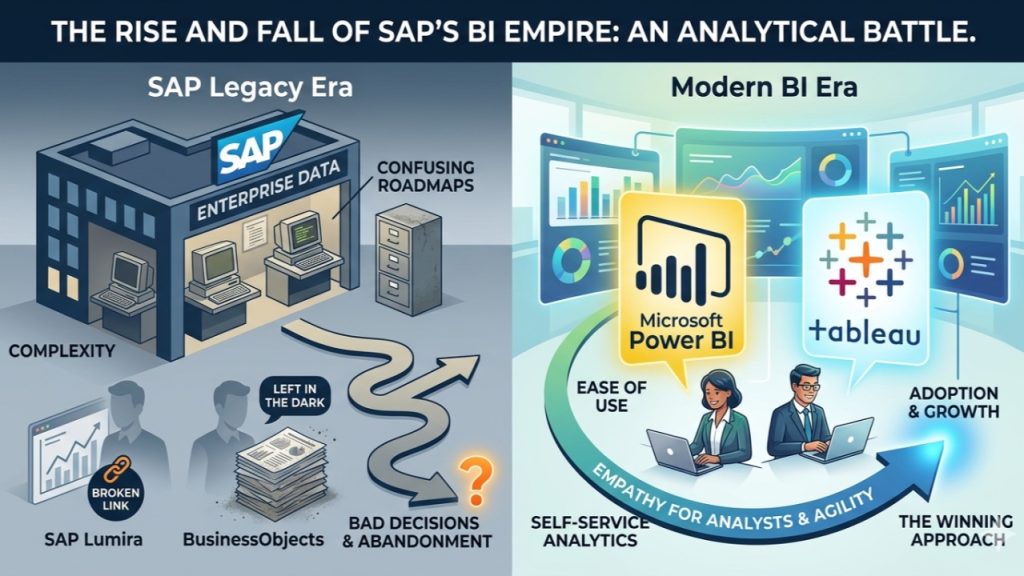
For decades, SAP was the undisputed king of the enterprise. But today, the conversation has changed. Despite a massive footprint, SAP failed to enamor the modern BI market, and the reason is not just competition — it is a story of internal strategic missteps.
The Lumira Experiment: A Masterclass in Bad Decisions
SAP Lumira was supposed to be the Tableau killer. It was promising, powerful, and deeply integrated. However, it was crippled by a series of decisions that made adoption harder than it needed to be.
Constant Rebranding and Pivot Fatigue
From Visual Intelligence to Lumira 1.0, then Lumira 2.0, users faced a confusing roadmap that changed every 18 months. For business teams trying to standardize reporting and visualization, that kind of uncertainty is exhausting. A BI platform cannot win hearts if the people expected to use it do not trust that it will still exist in the same form next year.
Technical Rigidity
While competitors focused on agility, Lumira required exact version matching between client and server, turning minor updates into deployment nightmares. What should have been simple refresh cycles became IT-heavy coordination exercises. That friction matters. Modern analytics tools won because they made experimentation feel easy.
Strategic Abandonment
Just as users started to adopt Lumira, SAP pivoted to SAP Analytics Cloud, essentially leaving Lumira Discovery to die in the shadows. This created a familiar SAP customer problem: invest in a tool, train your people, build internal standards, and then watch the roadmap move somewhere else.
BusinessObjects: The King Left in the Dark
After acquiring BusinessObjects for $6.8 billion, SAP had the gold standard of enterprise reporting. BusinessObjects was mature, trusted, and deeply embedded in the reporting operations of large companies. But instead of using that position to define the next generation of BI, SAP allowed the product to feel increasingly old-fashioned.
Halted Evolution
SAP prioritized its own Cloud First agenda so aggressively that BusinessObjects was essentially left in the dark for years without major user interface or self-service innovations. The back-end strength remained, but the user experience failed to keep pace with what analysts and business users were learning to expect elsewhere.
Complexity Over Comfort
While Microsoft made Power BI feel like Excel, SAP kept BusinessObjects locked behind complex Universes and IT-heavy workflows that modern business users simply will not tolerate. In the old BI world, business users waited for IT to model and publish everything. In the modern BI world, users expect to explore, iterate, and publish insights quickly.
Why the Shift Happened
The Ease-of-Use Gap
SAP BI tools, particularly legacy ones like Lumira, were often seen as rigid and complex. Power BI democratized data with an interface as familiar as Excel, while Tableau made advanced visualization feel like an art form. That emotional factor matters. Analysts adopted the tools they enjoyed using.
The Cost of Entry
SAP’s licensing models have historically been higher and more complex. Microsoft disrupted the market with a low-cost, entry-level strategy that allowed small teams to start for just a few dollars per user. That made pilots easy, adoption organic, and internal expansion almost inevitable.
Performance and Agility
While SAP tools are powerful within their own ecosystem, connecting them to non-SAP data often feels like a chore. Power BI and Tableau built their empires on being data agnostic. They do not care where your data lives; they just make it easier to analyze and visualize it.
Strategic Stumbles
Products like SAP Lumira Discovery, SAP BusinessObjects, and SAP BW failed to gain the long-term modern traction SAP needed. Deprecations, unclear roadmaps, and overlapping product strategies created tool fatigue among users. Once trust erodes, even technically capable platforms struggle to recover.
By the time SAP tried to catch up with SAP Analytics Cloud, Microsoft Power BI and Tableau had already won the hearts and desktops of the world’s analysts. SAP remains a powerhouse for finance and back-end data, but as a loved BI brand, that ship sailed because of SAP’s own tactical errors.
Is your team still stuck in the SAP BO, BW, or Lumira shadow, or have you moved to the light of modern BI?